
Literacy Solutions for
Families and Schools
VCu helps struggling readers make meaningful progress—and equips schools to move literacy forward with responsive practices.

VCu is Vowel Consonant university.
A learning world where readers build skill, meaning, curiosity, and confidence.
Literacy difficulty rarely stays on the page.
When learners cannot access instruction, the effects can impact confidence, independence, classroom participation, and willingness to keep trying.
Families, teachers, and schools may invest increasing amounts of time, effort, and support without seeing the progress the learner is capable of making.


Have you experienced weeks and weeks of instruction—with little progress?


The difficulty may look like sounds that will not stick, words that will not blend, spelling that disappears after practice—or a learner who can read the words but cannot understand or retain their meaning.
More practice. More repetition. More worksheets. Reading together every night.
More supports, more time in small groups, intervention, private tutoring. You may have changed programs, added support, and worked harder—only to see progress remain slow, inconsistent, or difficult to carry into new situations.
This can leave families wondering what else to try, educators carrying the weight of unmet needs in classrooms with diverse learners, and learners beginning to lose confidence in their ability.
What becomes possible when learners can access instruction?
Skills begin to connect. Learners progress.
Learners can use what they know more independently, communicate their understanding, and approach challenges with greater confidence.
Families gain a clearer path forward. Educators gain responsive ways to reach more learners. Schools can turn support into consistent practice with measurable growth.
VCu Access Point Instruction
Find the Access Point
Where is learning breaking down?
We look beneath visible patterns of difficulty to identify where access is breaking down and guide responsive instruction for individual learners, groups, or broader student populations.
Build the Foundation
How do we make learning stick, then intentionally increase challenge?
Practice is designed—not simply increased. We use explicit learning routines, memory-informed tools, personally meaningful experiences, and carefully calibrated challenges so learners can strengthen new skills without being overwhelmed by too many unstable demands at once. As skills become more secure, we intentionally increase the cognitive demand so learners can retain, apply, and use what they've learned with greater independence.
Turn Practice into Progress
What needs to become stable enough to support the goal?
We strengthen the essential language, literacy, executive-function, and learning skills that support academic progress and greater independence.
Different learners. Different barriers. Progress you can see.
VCu supports general education learners and learners with Specific Learning Disabilities, ADHD, speech and language impairments, autism, and complex developmental profiles.
Randall: Progressed from a two-word oral response to a detailed four-sentence retell, successfully tracking meaning across a three-paragraph text.
Parker: Increased from 1 out of 10 correct on school spelling tests to 6 out of 10 after five lessons.
Shante: Increased from 20% to 80% accuracy distinguishing commonly reversed letters.
Trinity: Increased accuracy answering grade-level, text-dependent questions from 30% to 90% and began independently self-correcting and monitoring meaning.
Eli: Entered second grade knowing eight letter sounds and unable to decode a single word. After two 12-week cycles, Eli was blending words, reading grade-level text, answering text-dependent questions, and no longer required regular additional intensive instruction from VCu.
Jeremy: Progressed from difficulty expressing what had been learned to producing coherent, structured responses; generating relevant questions; and using information to construct meaning rather than selecting between two provided answers. The family also reported increased language use at home.
Names have been changed to protect student privacy. Progress was monitored through curriculum-based literacy measures, running records, schoolwork, instructional work samples, and direct observation.
Explore VCu Services
Support for families, schools, districts, and Regional Center families.
When your child needs more than additional practice
VCu provides individualized literacy assessment and instruction for learners struggling with reading, language, or comprehension. We look beneath the visible difficulty, identify where access may be breaking down, and build instruction from what the learner already understands.
Services may include:
Informal literacy assessment
Individual or small-group instruction
Parent guidance and educational consultation
Want help determining your reader's next step?
Explore Family Support →
For Families
For Schools and Districts
Professional learning that becomes classroom practice.
VCu helps schools strengthen literacy instruction through practical professional development, targeted student programming, and systems that make existing resources more effective—without placing another overwhelming initiative on teachers.
Services may include:
Professional development and instructional coaching
Literacy pilots and targeted student programming
MTSS, intervention, and curriculum implementation support

For Regional Centers and Agencies
Building the skills that make learning—and daily life—more accessible.
VCu provides individualized educational intervention for learners with developmental and learning differences. We strengthen the underlying language, thinking, and organizational skills that help learners access academic instruction, understand their environment, complete everyday tasks, and participate with greater independence.
Support may address:
Organizing information and communicating understanding
Applying language and academic skills in functional contexts
Building structured learning routines for greater independence
The VCu Difference
VCu begins with a simple belief: difficulty does not mean inability. When a learner is not progressing, we look for the correct access point.
We don't remove challenge. We place it where learning can happen.
Trust comes first. Learners have a voice in the process, and we keep our promise to listen. We make new learning accessible, build stability and success, and introduce greater challenge intentionally.
Over time, learners discover something important: when the work gets harder, they won't be left alone in the struggle. They can trust the process, take the risk, and keep trying.
Instruction is intentional, evidence-informed, and grounded in dignity, curiosity, and simplicity. We teach clear learning routines, connect skills to meaningful use, and adjust when progress stalls.
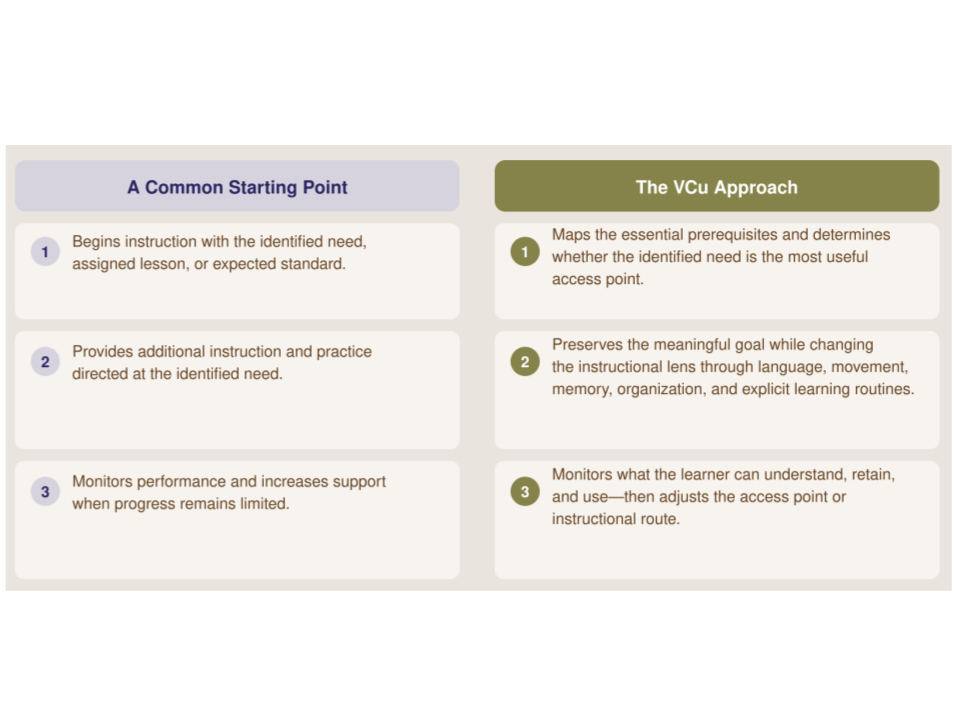
The goal stays meaningful. The route can change.
When a learner struggles, simply increasing repetition can increase frustration without addressing what's blocking access. VCu identifies the skills and demands underneath the task, then adjusts the instructional route while keeping the meaningful goal in view.
We stabilize what needs to become secure enough to support the goal, use memory-informed tools and personally meaningful contexts to strengthen learning, and intentionally increase challenge as the learner is ready for it. The difference is knowing where to begin, what supports to combine and when to change course.
The goal isn't easier learning. It's better-designed learning.
Meaningful goal. Responsive Map.
Shalott Hazzard is an instructional specialist, reading interventionist, and former special education leader who helps learners access literacy, language, and academic instruction.
Through VCu Education Solutions, she partners with families, schools, and agencies to identify what is getting in the way of progress and build practical, evidence-informed pathways forward.
Meet the Founder


Reserve Your Consultation
A thoughtful conversation about your goals, questions, and the clearest path forward.